

Best 10 Masterpiece AI Prompts for Hyper Realistic Digital Renderings of Sci-Fi Technology
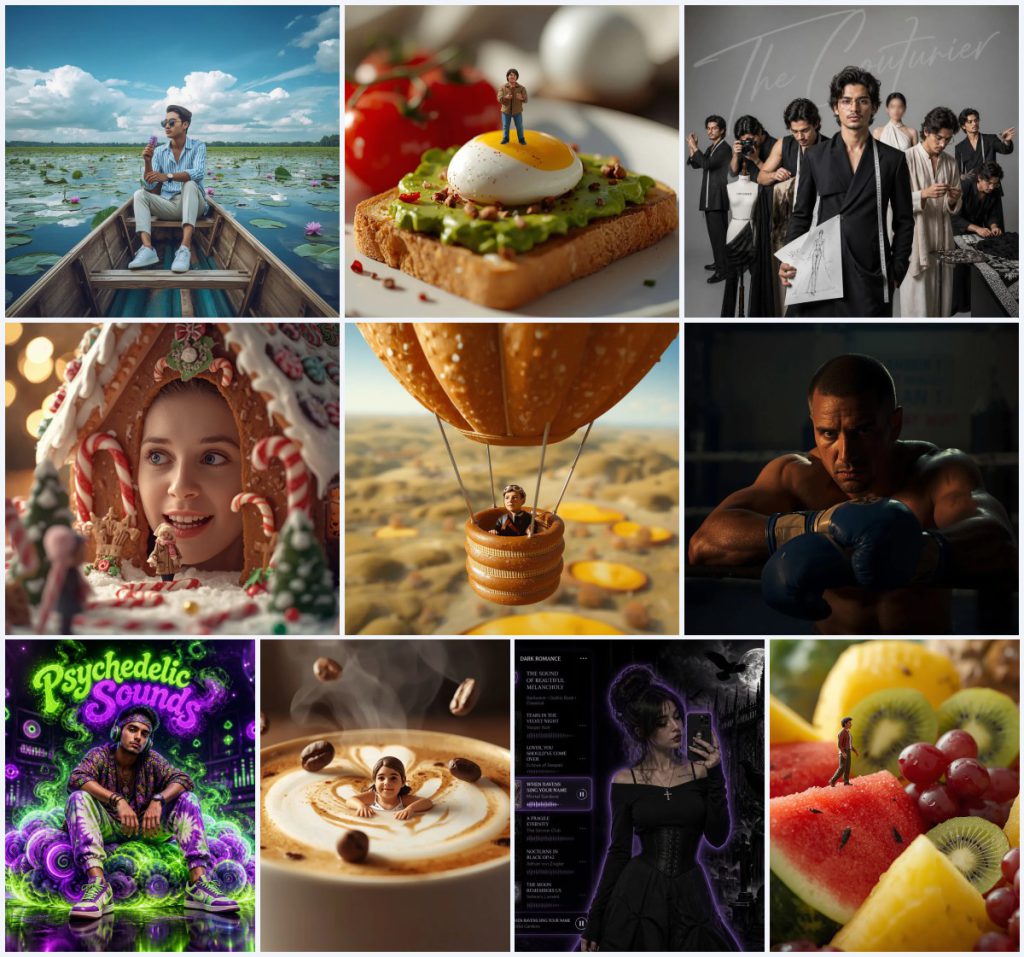
This collection gathers ten distinct prompts that all chase the same goal: a hyper realistic digital rendering where a real uploaded face sits inside an impossible or highly stylized world. Some of the cards are miniature food fantasies, some are neon music portraits, and some are gritty cinematic transformations. The shared thread is identity preservation paired with a scene that would be expensive or impossible to shoot with a camera.
Because the set mixes so many subjects, the article treats it as one body of work rather than ten separate pages. You will see how the uploaded photo is used as the exact facial reference, how scale illusions are built from giant food objects, and how lighting language changes from soft cafe warmth to hard night flash. The same generation habits apply whether you are placing yourself on avocado toast or on a psychedelic cloud.
What these hyper realistic sci-fi and fantasy prompts are asking for
Each card starts from a real photograph of you and then rebuilds the world around that face. The instructions are unusually strict about identity, so the generator is told to preserve facial features, skin tone, and hairstyle rather than invent a new person. From there the prompts branch into different genres, but they all keep the subject clearly readable in the frame.
Concrete details that appear across the collection include:
- An uploaded photo used as the exact facial reference with identity preserved at high accuracy.
- A miniature human occupying roughly 15 to 35 percent of the frame in the food fantasy cards.
- Giant food objects such as avocado toast with a poached egg, a salted pretzel balloon, a latte cup, and a fruit platter.
- Lighting language that ranges from soft cafe warmth and bright natural light to a powerful warm flash in a dark gym.
- Neon color palettes in green and deep purple, with swirling smoke, shimmering particles, and psychedelic bokeh.
- Aspect ratios and quality tags such as 4:5 portrait, 1:1 square, photorealistic, and 8K resolution.
The scenes inside this ten-prompt set
Several cards build a scale illusion. In one, the subject stands on "a giant slice of avocado toast, topped with a perfectly poached egg" while "giant cherry tomatoes and microgreens add to the vibrant landscape." Another sends the same tiny figure soaring in a balloon "made from a giant, perfectly salted pretzel" above "a landscape of enormous cheese dips and mustard puddles." A third places the subject "swimming gracefully in a giant, steaming cup of latte art coffee" with "giant coffee beans float nearby like tiny islands."
The remaining cards move in a different direction. One asks for a boxer "leaning against the ropes in a dimly lit, gritty boxing gym" lit by "a powerful, warm flash source positioned slightly behind and above." Another turns the subject into a music icon "sitting confidently on a swirling, glowing green and purple psychedelic cloud." A gothic mirror selfie card adds "a bold deep purple glow outline cutout effect" against "a haunting collage of faded Gothic architecture." Each scene is specific enough that the model has very little room to improvise.
Why this set works for portrait experiments
First, the identity lock is stated before the scene, which means the face usually survives even when the environment changes dramatically. Second, the prompts describe scale, lighting, and materials in the same breath, so the model gets a coherent brief instead of a vague mood. Third, the variety inside one collection lets you test the same uploaded photo against warm cafe light, hard flash, and neon glow without rewriting your base reference. That makes the set useful for comparing how different lighting treatments flatter the same face.
- Food fantasy macro: The miniature cards lean on macro food photography language, where the avocado, pretzel, latte, and fruit textures stay sharp while the background falls into shallow depth of field.
- Cinematic night flash: The boxing gym card uses a dark, naturally unlit room with a warm flash behind and above the subject, producing a hard rim light and a gritty documentary feel.
- Neon psychedelic portrait: The music icon card wraps the subject in green and purple neon with swirling smoke and shimmering particles, pushing the portrait toward a retro-futuristic poster look.
How to run these prompts on your own photo
The workflow is the same for every card in the set, so you can move between them without relearning the process. Start with a clean, well lit portrait, then let the prompt do the world building.
- Copy the prompt. Open the card you want and copy the full text, including the identity clause and the aspect ratio line.
- Upload a reference. Attach a sharp, front facing photo with even lighting so the model has enough detail to preserve your features.
- Generate the first pass. Run the prompt once without edits and study the result before changing any wording.
- Check hands and face. Zoom in on fingers, ears, and the jawline, since these are the areas most likely to drift from the reference.
- Inspect the main object. Look closely at the giant food item, the pretzel texture, or the neon cloud to confirm it reads as the intended material.
- Adjust and rerun. Tweak one clause at a time, such as lighting or scale percentage, then regenerate to compare.
Choosing the reference photo
The reference image does most of the heavy lifting, because every card in this collection depends on exact facial preservation. A photo that already looks like the final mood will save you several generations.
- Use a front facing shot with soft, even light so skin tone and facial structure stay accurate.
- Avoid heavy filters, sunglasses, or strong shadows that hide the eyes and cheekbones.
- Keep the background simple, since the prompt will replace it with a gym, a lake, or a neon cloud anyway.
Tools that handle these prompts well
Different platforms treat identity reference and scene text differently, so it helps to know what each one is good at before you commit a long prompt to it. The table below maps four common options against the needs of this set.
| Tool | Access | Typical realism | Useful here for |
|---|---|---|---|
| ChatGPT | Free and paid tiers | Good with text, moderate with faces | Rewriting the identity clause so the miniature human stays about 25 to 35 percent of the frame. |
| Google Gemini | Free and paid tiers | Strong scene understanding | Handling the giant avocado toast and poached egg layout with correct scale relationships. |
| Leonardo AI | Free credits, paid plans | High realism with tuning | Rendering the crunchy pretzel texture with visible salt crystals in the balloon card. |
| Midjourney | Paid subscription | Very high realism | Producing the warm flash rim light in the gritty boxing gym portrait. |
Tips that use the actual objects in these prompts
Small wording changes around the real props make a visible difference. These three habits are worth building before you run the whole set.
- Describe the poached egg yolk as glistening and the avocado as spread generously, which keeps the food fantasy card from turning into a flat illustration.
- Mention the salt crystals on the pretzel balloon explicitly, because that texture cue is what sells the snack advertising look.
- Keep the green and purple neon split even on the psychedelic cloud card, since an unbalanced palette flattens the swirling smoke and particles.
Common failures and what to change
Most problems in this set come from the model drifting on identity or scale rather than from the scene description. The fixes are usually one clause away.
| Issue | What to change |
|---|---|
| Face drifts from the reference | Strengthen the identity sentence and upload a sharper, better lit photo. |
| Miniature figure looks too large | Lower the frame percentage, for example from 35 percent to 20 percent, and restate it. |
| Food object looks plastic | Add material words such as glistening yolk, visible salt crystals, or dew drops on the fruit. |
| Neon card turns muddy | Separate the green and purple light sources and remove competing color words. |
Frequently Asked Questions
Can I use one photo for all ten prompts in this set?
Yes, a single clean front facing portrait works for every card, because each prompt only changes the scene around the preserved face. Just make sure the original photo is sharp and evenly lit.
Why do the food fantasy cards mention a percentage of the frame?
That number controls the scale illusion. When the miniature human occupies roughly 15 to 35 percent of the image, the giant avocado toast, pretzel, or latte cup still reads as enormous.
Do I need a paid tool to get the neon and night flash looks?
No, free tiers can produce usable results, but paid plans usually give you more control over identity reference and lighting consistency across reruns.
Conclusion
This collection is less about ten separate tricks and more about one reliable habit: lock the face first, then describe the world in physical detail. Whether the scene is a calm lake with purple lotus flowers or a boxing gym under hard flash, the prompts that name materials, scale, and light source are the ones that render cleanly. Pick two or three cards, run them on the same reference photo, and compare how each lighting setup treats your features. That comparison teaches more than running all ten at once.